

India’s Rising Heat Is Testing Our Power Distribution Systems
India's Rising Heat Is Testing Our Power Distribution Systems
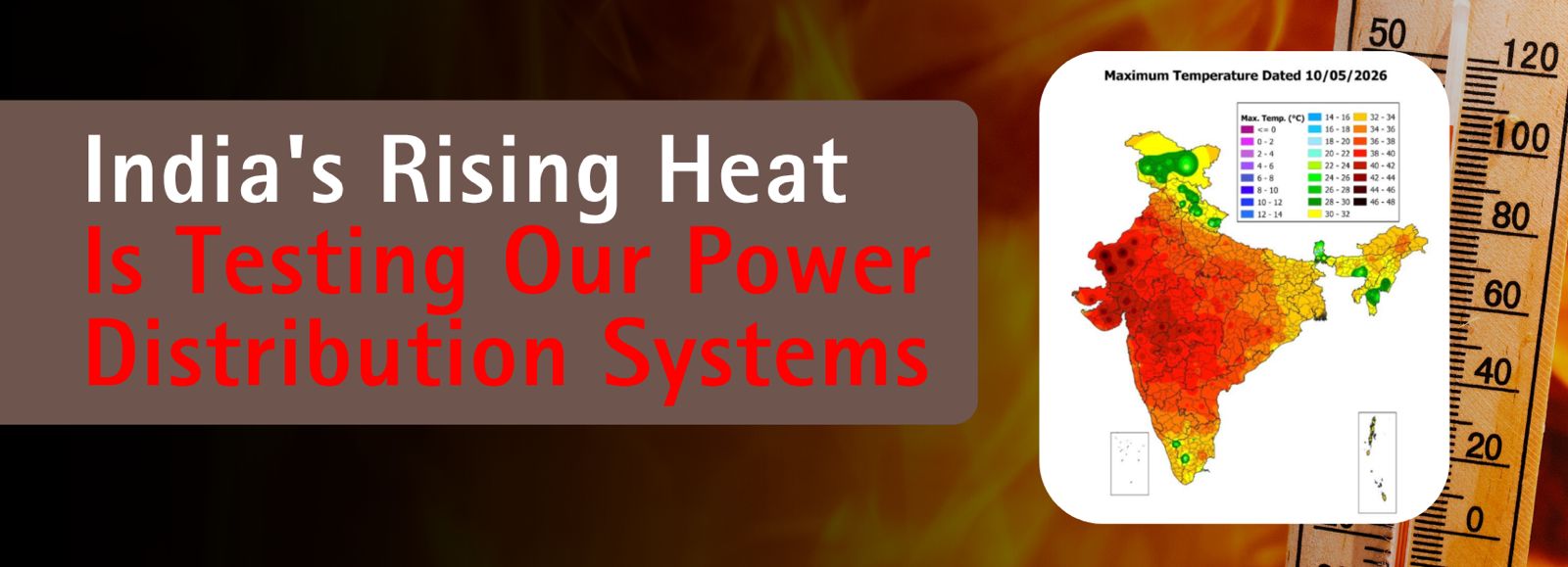
As temperatures cross 40°C and heatwaves grow more frequent, the real question isn't just how much electricity we can generate it's whether our last-mile infrastructure can carry it reliably.
Are our electrical systems being designed for the heat conditions they now face? Every summer, the answer becomes harder to ignore.
01 Heat & Demand
Heat Is No Longer a Seasonal Issue
India's summers have changed. Heatwaves arrive earlier, last longer, and routinely push temperatures to levels that were once exceptional. What was a rare extreme is fast becoming the new normal and that shift has profound consequences for the country's power infrastructure.
The connection is direct: when temperatures rise, air conditioners and coolers run longer and harder. Millions of cooling devices switching on simultaneously creates sharp, sudden spikes in electricity demand. National-level data shows that demand surges by roughly 7–8 GW for every single degree Celsius rise above historical summer norms. During a sustained heatwave, that surge doesn't ease overnight. Equipment that might recover during cooler hours is denied the chance.
Urban areas face an even steeper challenge. The India Meteorological Department confirms that city temperatures run 2–6°C higher than surrounding rural regions the Urban Heat Island effect meaning the equipment serving the most crowded load centres also endures the harshest thermal conditions.
And this is no longer a one-off weather anomaly. Climate scientists now point to the Super El Niño effect as a recurring accelerant a climatic pattern that periodically drives temperatures well beyond already elevated norms, compressing the margin between design capacity and operational reality. This is going to be a recurrent phenomenon. If we do not upgrade or uprate our systems and distribution transformers sufficiently, we should not be surprised to see a sharply higher rate of premature failure of critical assets not once in a decade, but season after season.
The result is a system under compounding pressure. Transformers that were designed for average conditions are now regularly pushed to and sometimes past their limits. Cables that were installed for a load profile from a decade ago now carry far more. Heat is no longer a weather challenge. It has become a power infrastructure challenge.
02 The Physics
What Happens Inside a Transformer During a Heatwave?
Electrical equipment generates heat as a natural by-product of doing its job. Transformers, cables, and conductors all produce internal heat under load. Under normal conditions, this heat dissipates into the surrounding air. But when outdoor temperatures are already elevated, that dissipation is far less efficient.
Think of it this way: a transformer already running at high load on a 45°C afternoon has nowhere to shed its internal heat. The surrounding air already hot offers little cooling relief. Internal temperatures climb. Insulation begins to degrade faster than designed. If the load doesn't ease and the heat doesn't drop, the equipment is slowly pushed towards death one day at a time.
When a transformer is already carrying high load, a heatwave can push it closer to failure not because the transformer was inadequate, but because it was never designed for the conditions it now faces.
Each factor alone is manageable. Combined, they push systems toward the failure threshold.
The problem is compounded by the choice of material used in distribution transformers. Conductors with higher electrical resistance generate more heat for the same amount of current carried. Poor conductor material increases resistance and therefore increases heat generation within the equipment itself. This internal heat adds to the external thermal stress, accelerating insulation damage, cable overheating, and ultimately, transformer failure.
03 Materials
Why the Choice of Conductor Material Matters
For years, the choice of conductor material in electrical transformers and distribution systems has been treated primarily as a cost decision. The question asked has been: which is cheaper? In a warming climate with rising load, a more important question is: which performs better under stress?
Source: ICA India / MSEDCL study. Creep data from laboratory testing of winding conductors under high thermal stress conditions.
Copper's advantage lies in its conductivity. Better conductivity means lower resistance for the same conductor size. Lower resistance means less heat is generated internally for the same load carried. In a high-temperature, high-load environment, that difference in heat generation becomes the difference between equipment that holds up and equipment that fails.
The quality of copper used matters as much as the choice of copper itself. Material that does not meet electrical-grade standards can underperform significantly. The benefit of copper is realised only when proper material quality is maintained throughout manufacturing and procurement.
In high-temperature, high-load conditions, the right conductor material can directly affect the reliability of the entire distribution system not just the life of a single transformer.
04 Field Evidence
Learning from Real-World Transformer Performance
Theoretical advantages are useful, but field performance under actual Indian summer conditions is the real test. A study conducted by ICA India in collaboration with MSEDCL (Maharashtra State Electricity Distribution Company Limited) in Wardha district offers exactly that kind of practical evidence.
Copper-wound transformers: sustained performance through peak summer heat
The study's approach is particularly instructive. Transformers that had already failed were rewound with copper windings and put back into the same distribution system. These were not tested under controlled laboratory conditions; they operated in the field, in Wardha's intense summer heat, under real demand loads. The findings indicate that copper-wound transformers can offer meaningfully better performance reliability in demanding field conditions.
This is not a claim that copper eliminates all failures. The finding is more specific: in conditions of high ambient temperature combined with high load, precisely the conditions that India's distribution systems increasingly face, copper-wound transformers showed stronger resilience.
05 Standards
India Needs Standards Built for Indian Conditions
Much of India's electrical infrastructure from equipment specifications to installation standards draws on frameworks developed for temperate climates with different load profiles. A standard developed for a country where summer peaks at 28°C and load growth is slow does not automatically translate into reliable guidance for a system where ambient temperatures regularly exceed 45°C and demand is growing rapidly year on year.
India needs electrical infrastructure standards and design practices that account for its actual operating environment: high ambient temperatures, rapid load growth, heatwave-induced demand spikes, and the urban heat island effect. This isn't an argument for abandoning international benchmarks it's an argument for adapting and extending them to reflect Indian realities.
Standards that only address today's load levels and today's climate conditions will be outdated before the equipment they govern reaches mid-life. The design life of a distribution transformer is 25–30 years. The climate those transformers will operate in will be meaningfully different from the climate of today.
06 Planning
Building for Future Heat, Not Past Load
The conventional approach to distribution infrastructure has been reactive: build or upgrade in response to failures and demand growth that has already occurred. In a climate that is changing faster than infrastructure cycles, that approach is increasingly untenable.
"The grid of tomorrow must be engineered for the climate of today not the one we inherited."
Future-ready planning means accounting for load growth that hasn't happened yet. It means sizing transformers not just for today's peak demand but for the peak demand that a hotter summer five years from now will generate. It means selecting conductor materials based on how they perform under sustained thermal stress, not just their upfront cost. And it means building maintenance and replacement cycles around climate projections, not just equipment age.
The good news is that the knowledge needed to make these decisions is available. Field studies like the Wardha research provide practical evidence. Material science gives planners and engineers clear guidance on how different conductors perform under heat. What is needed is the institutional willingness to let reliability and not just cost drive procurement, design, and standards decisions.
India faces a clear choice: continue reacting to transformer failures each summer, or invest in building a distribution system that can withstand the summers ahead. The second path requires different conversations in procurement offices, in DISCOM planning departments, and in the standards bodies that define what India's electrical infrastructure must achieve.
Atmanirbharta can succeed only if reliable electricity supply is given to citizens all the time and not plagued by the frequent, premature failure of the very assets that carry that power to their doors. A self-reliant India needs a self-reliant grid.
The Last Mile Must Be Ready
India's electricity demand will continue to rise driven by economic growth, urbanisation, and, increasingly, by the need to cool a warming country. The question is not only how much power we can generate. It is whether the last-mile distribution system can carry that power reliably to every home, hospital, school, and business that depends on it.
Better conductor choices, copper-based solutions where conditions demand it, stronger and India-specific standards, and long-term planning that accounts for future heat and future load these are the levers available to policymakers, DISCOMs, and infrastructure planners today.
The 1.3 million distribution transformer failures that India sees every year are not inevitable. Many of them are a consequence of systems designed for conditions that no longer exist, using materials selected for cost rather than performance, maintained reactively rather than proactively. That can change.
Climate change & thermal stress on India's power infrastructure is no longer seasonal it is a structural reality. The infrastructure response must be equally structural.