Driving the Green Shift: Decarbonizing India
Driving the Green Shift: Decarbonizing India
The clean energy transition will require not only innovation, investment and new technologies, but also the materials that make these systems possible.
India's transition towards a cleaner and more electrified future is often described through the technologies at the centre of it—electric vehicles, renewable energy, digital systems and advanced infrastructure.
The clean energy transition will require not only innovation, investment and new technologies, but also the materials that make these systems possible. Among them, copper has a particularly important role to play. With its ability to be recycled indefinitely, copper acts as an “abatement multiplier”, enabling electrification, improving energy efficiency and advancing a more sustainable industrial future.
01Material behind clean Energy technologies
The shift towards clean energy is, at its core, a shift towards greater electrification.
Electricity must be generated, transmitted, distributed and used efficiently. As economies adopt more electric technologies, the demand for materials that can conduct electricity safely and reliably will continue to grow.
This is where copper's properties become particularly valuable.
Copper is conductive, safe, durable, antimicrobial, anticorrosive and 100% recyclable. These characteristics make it suitable for a wide range of applications across electrical systems and clean energy technologies.
The International Energy Agency (IEA) has identified copper as a key material across clean energy technologies, recognising its essential role in electricity networks, electric vehicles, renewable power generation and energy storage.

NITI Aayog projections further underline copper's critical role in India's clean energy transition such as (Renewable energy, EV Motors, Battery energy storage systems) with Cumulative demand expected to reach 66,069 kilotonnes between 2025 and 2070—far exceeding the projected requirements for several other minerals.
02A Glimpse Clean Energy : EV
The electric vehicle offers a clear example of copper's role in the green shift. An EV contains approximately 67.5 kg of copper per vehicle. Copper is used across multiple systems, including the battery pack, drive system, control motor, cables and connectors, and electronic systems.
The battery pack uses copper foil, strip and wire. The drive system uses copper wire and rod. Copper is also used in copper tubes for the electromotive air-conditioning system, copper wire in the control motor, and copper wire and strip across cables, connectors and electronic systems.
In other words, copper is not limited to one part of the EV. It runs through the vehicle's electrical architecture.
03The abatement multiplier
Copper's contribution to decarbonisation becomes even more significant when its role is viewed beyond its own production footprint.
According to the International Copper Association, one tonne of copper cathode represents 4.6 tonnes of CO₂e, but contributes to abating much higher emissions when used in various clean energy technologies.

Copper is not the only material needed for clean technologies, but its role in electrical systems means that it is deeply connected to the transition towards a more electrified future.
04Decarbonisation cannot be separated from circularity
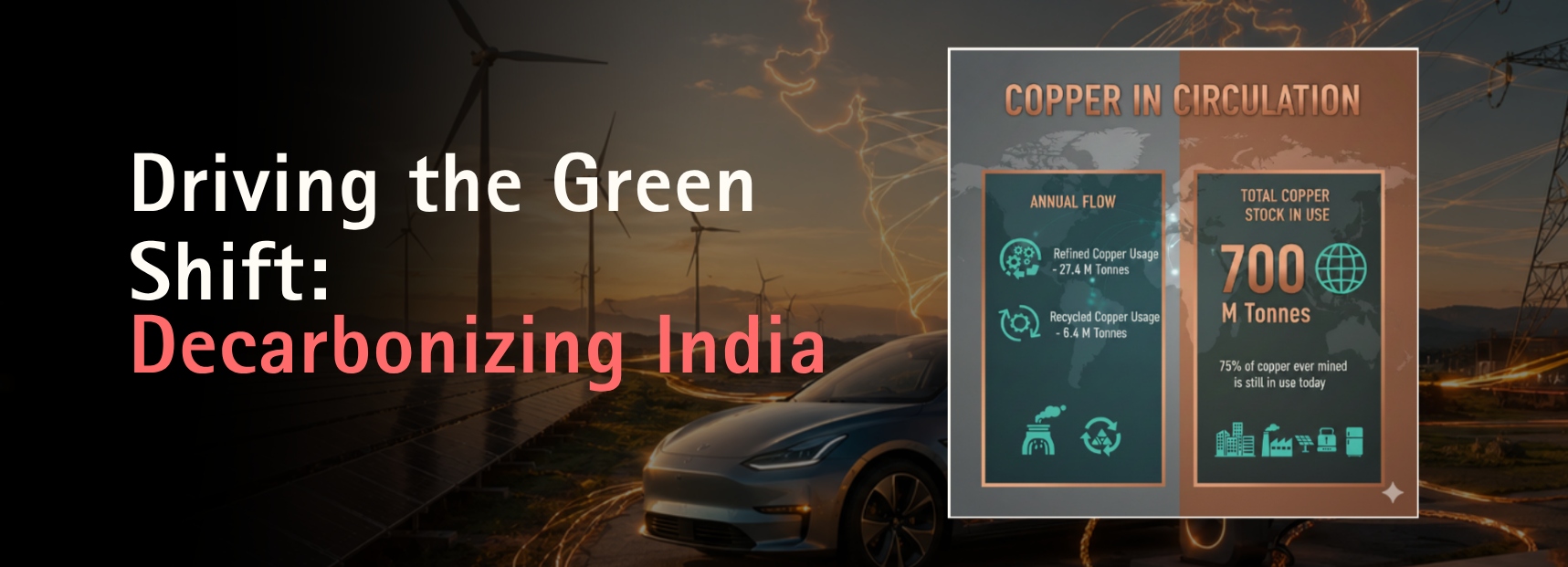
Copper is one of the only metals that can be infinitely recycled without losing its properties. In fact, 75% of all copper ever mined is still in use today. What makes copper one of the most recycled materials is its various unique properties. Copper is corrosion-resistant; hence, at the end of a product's life, the copper inside can be extracted and recycled for reuse. Unlike many other materials, copper is mainly used in its purest form, making it easy to recycle by simply removing impurities. Copper also boasts one of the highest end-of-life collection rates because its distinct colour makes it easy to identify, and it holds a higher economic value compared to other metals.

A truly sustainable material is one that remains in circulation. Copper is 100% recyclable and reusable, enabling it to be recovered, repurposed and reintegrated repeatedly without loss of performance—creating zero waste and supporting a true cradle-to-cradle ecosystem. By maximizing recovery and reuse, we can conserve resources, reduce energy consumption and close the circularity loop for a more sustainable future.
Copper's infinite recyclability and essential role in electrification and decarbonization make it a strategic enabler of India's green transition, supporting a circular, resource-efficient economy and sustainable growth.
Driving the green shift
India's green transition will depend on technologies that enable greater electrification, efficiency and connectivity—and copper will be central to making that transition possible. From electric vehicles and clean energy systems to digital infrastructure, copper enables the technologies that can deliver significant emissions reductions. Its high recyclability further strengthens the circularity of the systems it supports.
As India moves towards a more electrified and sustainable future, copper will remain not just an essential material, but a critical enabler of the country's green transition.