

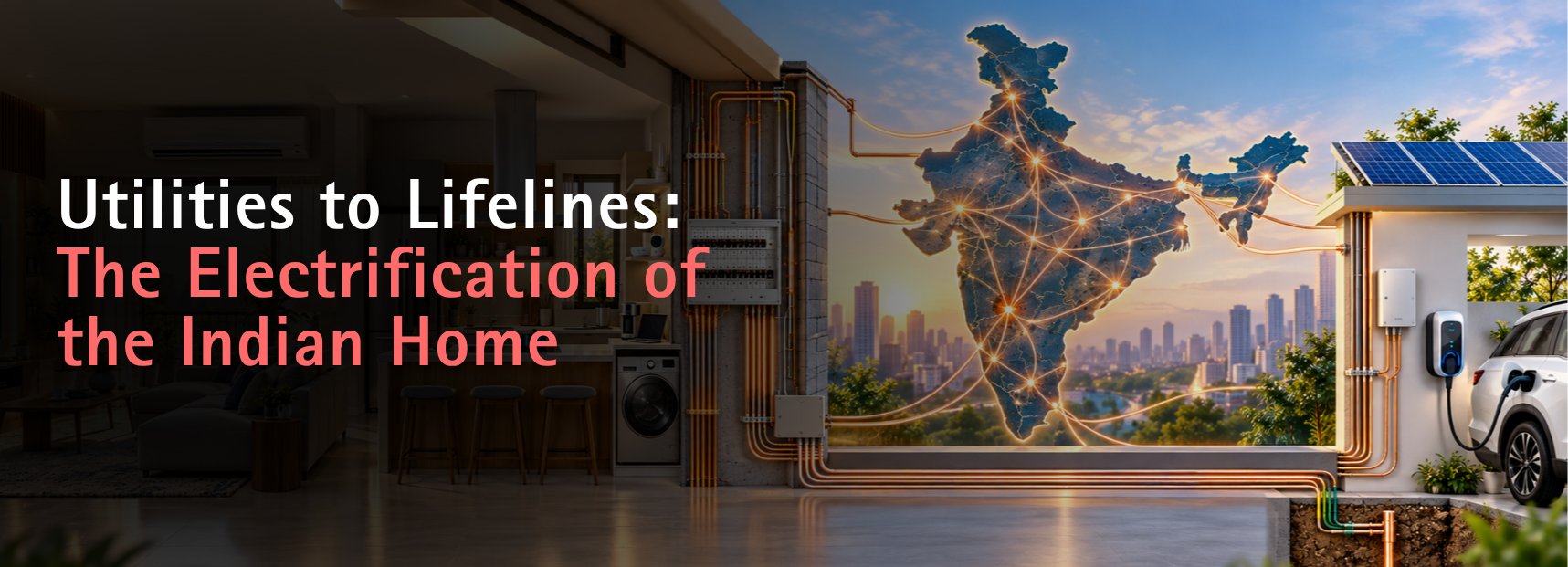
Utilities to Lifelines: The Electrification of the Indian Home
Utilities to Lifelines: The Electrification of the Indian Home
Electricity, once treated largely as a utility, is becoming fundamental to everyday life, making copper increasingly essential to powering modern society
Only Copper cables & compact busbar for buildings
Copper cables for internal cabling in critical public buildings, EV charging & solar rooftop
There is a quiet transformation taking place inside Indian homes. It is not visible in the architecture or the interiors. It does not show up in the number of rooms, the size of the kitchen or the view from the balcony. Yet it is changing the way homes are designed, lived in and powered. The Indian home is becoming increasingly electric.
Fans and lights have long been staples of household electricity consumption. Today they share the electrical system with air conditioners, refrigerators, washing machines, water heaters, induction cooktops, televisions, computers, routers and an expanding universe of connected devices. Electric vehicles are adding another dimension, bringing charging infrastructure into residential spaces. Electricity, once treated largely as a utility, is becoming fundamental to everyday life.
01The infrastructure we don't see
When buying a home, most of us instinctively examine what is visible: the location, layout, finishes, fittings, kitchen and bathrooms. We count electrical points for televisions, refrigerators and air conditioners. Yet it is far less common to ask about the quality of the cables running behind those points. Internal cabling is concealed by design. Once the walls are finished, the infrastructure disappears, but invisibility should not be mistaken for insignificance. For homebuyers, electrical safety belongs on the checklist well before possession, alongside the finishes and the floor plan.
As household electricity consumption becomes more intensive, the internal cabling and electrical systems within a building carry greater responsibility. Incorrectly selected or sized conductors, overloaded circuits, inadequate earthing, poor installation practices and non-compliance with applicable standards can create risks that may remain unnoticed until something goes wrong.
02The conductor at the heart of the system
Copper has been central to electrical systems for more than a century, and its relevance has not diminished with technological change. If anything, the electrification of homes is reinforcing its importance. Its high electrical conductivity allows it to carry current efficiently. Its durability and flexibility make it well suited to cables in buildings and electrical installations, while its resistance to corrosion supports long service life when used appropriately.
An air conditioner, for example, can place a considerably higher demand on an electrical circuit than a light or ceiling fan. Add a geyser, washing machine, oven or other high-load appliances, and the electrical infrastructure must be designed to handle a very different pattern of consumption from the homes of previous generations.
03Efficiency begins behind the wall
Energy efficiency is usually discussed in terms of appliances. But efficiency does not begin at the appliance. It begins earlier, with the infrastructure that delivers electricity to it. Electrical resistance results in energy being lost as heat, so the characteristics of the conductor matter to the efficiency of power delivery. Copper's high conductivity means that, in an appropriately designed electrical system, it can provide a low-resistance pathway for current. This is one reason copper remains so widely used across electrical infrastructure.
India's growing electricity needs make it increasingly important not only to generate more power, but also to deliver and use that power efficiently. Every reduction in avoidable electrical loss contributes to making the overall system work harder and smarter.
04A home designed for tomorrow
The Indian home is beginning to interact with technologies that were uncommon in residential spaces only a few years ago. Rooftop solar can turn a home into a small-scale generator. Electric vehicles can turn a parking space into an energy-consuming asset. Smart appliances and connected devices are adding new loads and changing patterns of consumption. Higher-load appliances may require dedicated circuits, while appropriate circuit protection, earthing and distribution are essential to a safe installation.
In this evolving environment, copper's combination of conductivity, durability and versatility gives it an enduring role. The cable installed in a home today may ultimately support a far more electrified lifestyle than the one imagined when the building was designed.
05Safety is a system
Copper is an important component of electrical infrastructure, but safe electrical systems result from multiple elements working together: correct conductor sizing, quality and certified electrical products, proper circuit design, effective earthing, appropriate protection devices, skilled installation, and regular inspection and maintenance. The benchmark has also moved. The revised National Building Construction Standard, SP 7:2026, now specifies mandatory copper cables upto 50 sqmm for internal cabling across all critical public building, closing a long-standing substitution gap.
A copper conductor that is incorrectly sized or improperly installed cannot compensate for poor system design. Conversely, good design and installation practices ensure that the properties of the conductor are used effectively. For homeowners, this means electrical safety deserves a place alongside the other considerations that accompany a major property investment. A home may have excellent architecture and premium finishes, but its most important infrastructure may be the part that remains completely out of sight.
06From the home to the city
The electrification of the Indian home is taking place alongside the electrification of the economy. Cities are demanding more power. Renewable energy is expanding. Electric mobility is growing. Data centres and digital infrastructure are increasing electricity requirements. Buildings are becoming more connected and increasingly dependent on electrical systems.
Copper runs through much of this transformation. It is used in conductors, transformers, motors, switchgear and electrical equipment. It plays an important role in renewable energy systems, electric mobility infrastructure, and the broader networks that connect electricity generation to consumption.
We notice the air conditioner cooling a room, but not the conductor supplying it. We notice the convenience of charging a device, but rarely the electrical network that makes it possible. From conventional power systems to renewable energy, electric mobility and digital infrastructure, copper tends to occupy that invisible space, connecting technologies to the electricity they require.
Conclusion
The transformation of the Indian home is ultimately a story of changing expectations. Where electricity was once a utility for basic lighting, it is now a lifeline powering high-load cooling, remote work, smart automation and residential EV charging. Every one of these visible possibilities depends on a simple necessity: safe, resilient and loss-efficient infrastructure behind the walls. A home's reliability is determined not by its appliances alone, but by the material carrying its power, working quietly behind plaster and switchgear. The future of the Indian home will be smart, connected and increasingly electric, and copper remains the foundation beneath it all.