

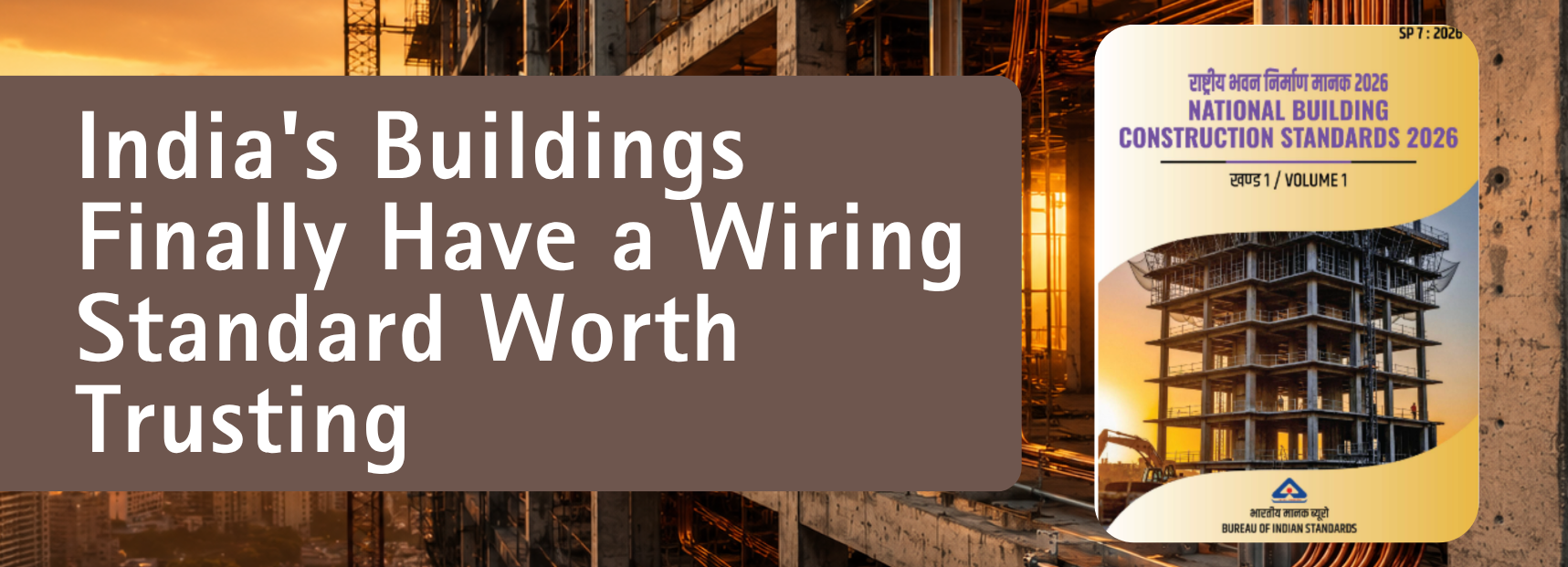
India’s Buildings Finally Have a Wiring Standard Worth Trusting
India's Buildings Finally Have a Wiring Standard Worth Trusting
The revised National Building Construction Standard 2026 mandates copper cables for internal cabling across building types, closing a loophole that put cost savings above safety for decades.
For years, the cabling inside India's buildings followed a standard that was quietly out of date. The revised NBCS SP 7:2026 has changed that and the implications stretch well beyond a line in a code document.
01 — The ProblemA Code That Left the Door Open to Risk
India's National Building Code had long specified copper cables for internal building cabling, but only up to 16 sq mm. For conductor sizes above that threshold, the code was silent. That silence created an opening.
Electrical contractors, working under pressure to reduce project costs, began routinely substituting aluminium cables for higher conductor sizes. Builders and developers, often unaware of the material difference or its implications, accepted the substitution. The economics made it easy to justify: aluminium is cheaper by weight, and to an untrained eye, a cable looks the same regardless of what is inside it.
The problem was not that builders were cutting corners deliberately. Many simply did not know the standard had a gap, and no one was telling them.
But the consequences of that gap are real. Aluminium cables in larger sizes carry a higher risk of issues at connection points, are more sensitive to thermal cycling, and require more careful installation to perform safely over the long term. In a country where buildings are getting taller, denser, and more electrically loaded every year, the stakes of getting internal cabling right are only going up.
02 — What ChangedThe Revised NBCS 2026: A Clear Mandate
The revised National Building Construction Standard, published as SP 7:2026 by the Bureau of Indian Standards, has addressed this gap directly. The new standard specifies copper-only cables for internal cabling across building categories, and the size thresholds have been raised significantly.
The revised thresholds are significant. Specifying 25 sq mm for general buildings and 50 sq mm for public and multi-storey buildings closes the substitution window that had existed for decades. There is now no ambiguity about what material must be used for internal cabling in any category of building that falls under the standard.
Source: Bureau of Indian Standards, NBCS SP 7:2026
03 — ICA India's RoleMonitoring the Evidence, Contributing to the Standard
ICA India has been closely monitoring electrical fire incidents across the country for several years. That on-the-ground tracking of real-world failures brought a body of evidence to the table: incidents where poor-quality or inappropriate conductor choices in internal cabling had contributed to dangerous outcomes. When the NBCS revision committee was constituted, ICA India was part of it, bringing that evidence base into the standards process.
Tracking the evidence, informing the standard
The pattern of electrical fire incidents tracked points to a consistent theme: failures at connection points, heat buildup in conduits, and cable degradation over time were disproportionately associated with non-copper conductors in higher sizes. That evidence, when brought into the committee process alongside international studies on conductor performance, built a technical case that the revised standard ultimately reflects.
04 — Why CopperThe Case for Copper in Internal Building Cabling
The justification for use of copper-only conductors in buildings is grounded in well-understood material performance differences that become especially relevant in the demanding electrical environments of modern buildings.
These advantages are amplified in the buildings where the new standard applies most stringently: public buildings and multi-storey structures. These are precisely the buildings with the highest occupancy, the longest service lives, and the most complex electrical loads, including lifts, fire suppression systems, HVAC, EV charging, and solar rooftop infrastructure.
A building's internal cabling is not replaced every few years. It is expected to perform safely for the life of the structure. The material choice made at construction is the one that matters.
05 — Broader ImpactWhat This Means for India's Built Environment
The revision of NBCS is not just a technical update to a standards document. It has practical implications that ripple across sectors and building types that are growing rapidly across India.
The timing of this revision is also important. India is in the middle of an unprecedented construction cycle. Smart cities, urban housing programmes, commercial real estate expansion, and infrastructure upgrades are all adding millions of square metres of new built space. The standards that govern how that space is wired will shape the safety and reliability of India's built environment for generations.
Atmanirbharta is not only about what India makes. It is also about the quality and safety of the infrastructure within which Indians live and work. Getting the cabling right is where that commitment begins.
06 — For Builders and DevelopersWhat You Need to Know Now
For builders, developers, and electrical contractors, the revised NBCS SP 7:2026 is now the reference standard. Projects that fall under its scope are expected to comply with the new copper specifications. This is not a recommendation. It is a code requirement backed by the Bureau of Indian Standards.
The practical implication is straightforward: building internal cabling specifications should be reviewed against the new thresholds before procurement and installation begin. Projects designed under the old code and still in progress should be assessed for compliance. Procurement teams should ensure that the cables specified on paper are the cables that actually go into the walls.
The cost differential between copper and aluminium at higher conductor sizes is real, but it needs to be weighed against the cost of rewiring, the liability of non-compliance, and the safety risk to building occupants over a structure's lifetime. On that full accounting, the case for copper is not close.
A Standard That India's Buildings Deserved
The revision of the National Building Construction Standard to mandate copper cables across size categories is a straightforward win: for building safety, for electrical reliability, and for the millions of people who occupy the structures governed by this standard.
It is also a reflection of what evidence-based participation in the standards process can achieve. ICA India's monitoring of electrical fire incidents and its technical contribution to the NBCS committee helped ensure that real-world performance data informed the revision. The studies reviewed during the process made clear that copper is the superior material for cables in buildings, and the revised standard reflects that finding.
India's buildings are growing taller, more complex, and more electrically loaded with every passing year. They deserve cabling standards that match that ambition. With NBCS SP 7:2026, they finally have one.
International Copper Association India