

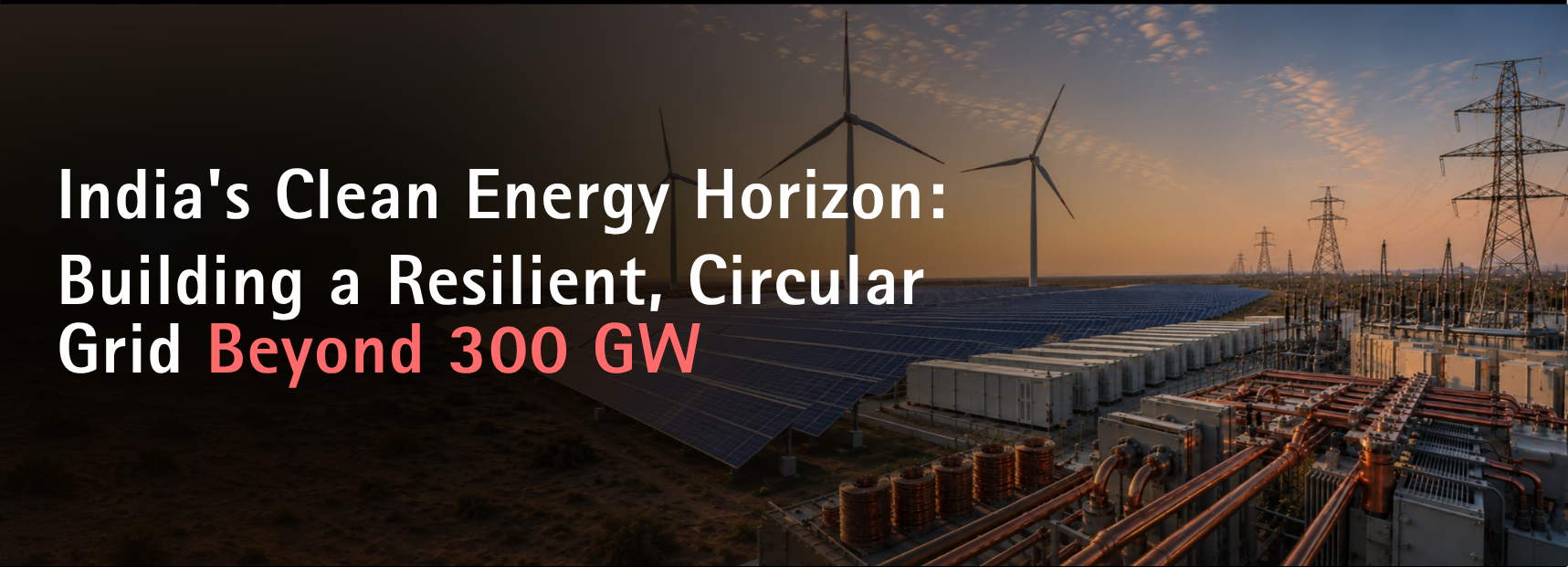
India’s Clean Energy Horizon: Building a Resilient, Circular Grid Beyond 300 GW
India's Clean Energy Horizon: Building a Resilient, Circular Grid Beyond 300 GW
As India works toward its 500 GW non-fossil capacity target for 2030, the conversation is shifting from “how much capacity can we build?” to “how reliably can this system perform over decades?”
India's clean energy story has moved into an important new phase. With installed non-fossil power capacity now crossing 300 gigawatts (GW), the country is no longer only adding solar parks and wind corridors at speed; it is also reshaping the way power is generated, moved, stored, and used.
As India works toward its 500 GW non-fossil capacity target for 2030, the conversation is shifting from “how much capacity can we build?” to “how reliably can this system perform over decades?”
That reliability will depend on more than panels and turbines. It will depend on the less visible parts of the system too: conductors, transformers, storage interfaces and the materials that allow them to operate safely under heat, load, and stress year after year.
01The Storage Imperative: Bridging India's BESS Gap
As more renewable power enters the grid, storage becomes harder to treat as optional. Solar generation peaks during the day, while demand often rises in the evening. Wind output can also vary sharply by region and season. Without enough storage, clean power may be curtailed just when the system needs flexibility the most.
India's utility-scale Battery Energy Storage System (BESS) capacity is still well short of what will be needed as intermittent renewable generation grows. To close that gap, the Government of India has introduced a set of policy measures aimed at making storage easier to finance, procure, and integrate into the power market:
- Viability Gap Funding (VGF)Capital subsidies designed to lower the initial capital expenditure of utility-scale BESS projects, accelerating private development.
- Energy Storage Obligations (ESO)Mandates requiring power distribution companies (DISCOMs) and merchant generators to procure a set percentage of their energy from storage systems.
- Framework for Energy Storage IntegrationGuidelines issued by the Ministry of Power to treat storage as a distinct, dispatchable asset class within national power markets.
02Material Integrity: Where and Why Copper Matters
The performance of renewable and storage assets is strongly influenced by the materials used in the balance of system. If conductors are inefficient, more energy is lost as heat. That loss may seem small at one point in the system, but across large solar parks, wind farms, battery banks, and substations, it can add up quickly.
This is where copper plays an important role. Its high electrical conductivity and strong thermal performance make it especially useful in the parts of clean energy infrastructure that carry heavy current or manage heat:
- Photovoltaic SystemsInside solar installations, copper is extensively deployed in inverter transformers, collector cables, junction box connectors, and earthing grids. High conductivity cabling reduces resistive losses between individual panels and main distribution hubs.
- Wind Energy GenerationModern multi-megawatt turbines rely on copper for generator windings, high-voltage nacelle transformers, and heavy-duty drop cables that withstand constant mechanical stress and torsion.
- Battery Energy Storage Systems (BESS)Within high-density battery packs, copper current collectors, busbars, and cell interconnects handle rapid charge and discharge cycles under heavy current loads. Furthermore, copper heat exchangers and liquid cooling loops efficiently dissipate operational heat, preventing thermal runaway and extending battery cell lifecycle.
- Grid Integration & SubstationsStep-up transformers, switchgear, and high-voltage transmission lines require copper's high thermal tolerance to manage continuous load fluctuations without thermal degradation.
In simple terms, better conductivity means less wasted energy. For developers, utilities, and consumers, that translates into more usable clean power and better returns from the infrastructure already being built.
03Engineering for Extreme Climates
India's energy infrastructure also must survive difficult operating conditions. Equipment may face extreme heat in desert regions, high humidity in coastal areas, corrosive salt air, and heavy seasonal stress. Since renewable assets are expected to run for 25 years or more, early material failure is not just a maintenance issue; it can affect generation, revenue, and grid reliability.
Copper is valued because it holds up well in these conditions. It resists corrosion, maintains reliable electrical contact over time, and supports effective earthing systems that protect power electronics from lightning strikes and voltage surges. In remote renewable projects, that kind of durability can reduce downtime and avoid expensive repairs.
04Closing the Loop: Circularity and End-of-Life Resource Security
A clean energy transition also must think beyond construction. In the coming decades, India will begin retiring its first large wave of solar modules, wind turbines, inverters, batteries, and related equipment. Planning now for what happens at end of life will be essential if the transition is to remain sustainable.
Copper offers an important advantage here because it can be recycled repeatedly without losing its key properties. Using recycled copper also requires far less energy than extracting and refining new copper from ore, which helps lower the carbon footprint of future manufacturing cycles.
For India, this turns today's clean energy infrastructure into tomorrow's material reserve. Copper used in solar inverters, battery busbars, transformers, and grid equipment can be recovered and reused, reducing import dependence and strengthening domestic supply chains over the long term.
Conclusion
India's 500 GW ambition is not only a capacity target; it is a test of how well the country can build a power system that is reliable, efficient, and sustainable at scale. As the grid becomes more complex, material choices will matter more. High-performance, recyclable materials such as copper can help India build an energy system that works well today and remains resilient for the decades ahead.