

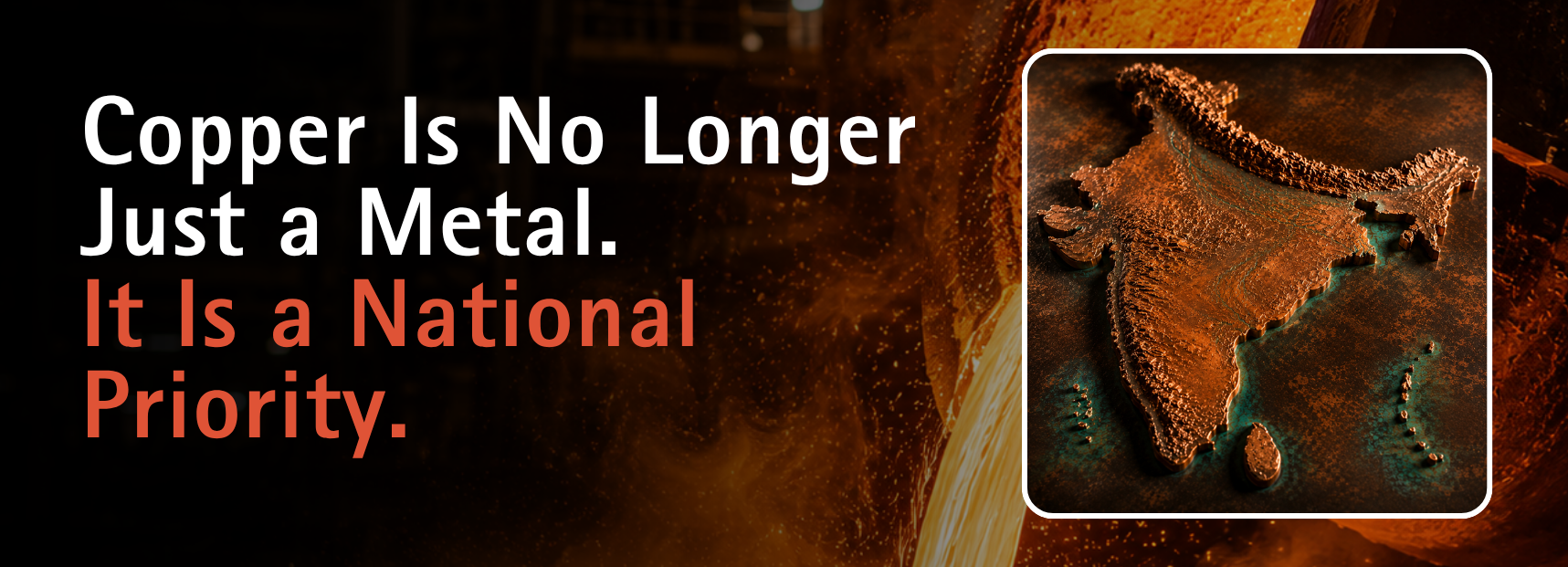
Copper Is No Longer Just a Metal. It Is a National Priority.
Copper Is No Longer Just a Metal.
It Is a National Priority.
Copper has moved decisively from an industrial commodity to a strategic enabler of India's growth and clean energy transition. The policy signals, the demand numbers, and now the investment decisions on the ground all point in the same direction.
Copper has moved decisively from an industrial commodity to a strategic enabler of India's growth and clean energy transition. The policy signals, the demand numbers, and now the investment decisions on the ground all point in the same direction.
01 — The SignalA Political Statement That Changed the Conversation
In May 2026, Prime Minister Narendra Modi addressed the issue of copper plant shutdowns directly, framing domestic copper production as inseparable from India's Atmanirbhar Bharat agenda. The statement was striking for its candour: India, once a copper exporter, had become an importer. And the Prime Minister named that reversal as a national concern.
For a sector that has long operated in the background of India's industrial economy, that intervention marked a turning point. Copper capacity is no longer a purely commercial question. It is a strategic one.
02 — The Policy ContextCopper as a Critical Mineral: What That Status Means
That political signal arrived on the back of a significant policy shift: the recognition of copper as one of India's 30 Critical Minerals. This classification by the Ministry of Mines elevates copper from a traded commodity to a material of strategic national importance, with all the policy attention and government prioritisation that comes with it.
What India's Critical Mineral classification means for copper
Critical Mineral status shifts the question from "should India invest in copper capacity?" to "how quickly can India build it?" That is a very different conversation.
03 — The Demand StoryThe Scale of What India Needs — and ~66 MnT of Cumulative Demand by 2070
The numbers tell their own compelling story. India's copper demand is not growing incrementally. It is on a trajectory that will require a fundamental transformation of domestic supply capacity.
These are not abstract projections. They follow directly from commitments India has already made: renewable energy capacity, mass electrification of transport, a nationwide EV charging network, smart grid infrastructure, urbanisation and the electrification of industrial processes. Every one of these programmes is copper-intensive.
India's energy transition and industrial growth will be constrained without a rapid scale-up of domestic copper capacity. The numbers leave no room for ambiguity.
04 — Industry ResponseCapacity Is Being Built — at Scale
India's copper supply gap is not going unaddressed. The private sector has read the demand trajectory and is committing capital at a scale that would have been difficult to imagine a decade ago. Two announcements in particular signal that the capacity build-out is already under way.
Taken together, these investments represent a structural shift in India's copper manufacturing landscape. Hindalco's brownfield expansion deepens an established integrated operation. Adani's Kutch Copper, if Phase II is delivered on schedule, would alone add more capacity than India's current total refined copper output. The scale of private capital commitment reflects precisely the kind of industry confidence that Critical Mineral status and sovereign-level attention are meant to catalyse.
When industry announces capacity at this scale, it is not responding to current demand. It is making a bet on where India will be in 2030 and beyond. That bet is being made now.
06 — What This MeansFor Policymakers, Industry, and Investors
The convergence of Critical Mineral status, a quantified demand outlook, and major private sector capacity commitments changes the operating environment for everyone connected to copper in India.
For every stakeholder in the copper value-chain, the implications are equally concrete. A country planning for 10 MnT of annual copper demand by 2047 needs copper-ready standards, copper-ready procurement, and copper-ready design practices across every sector that touches the metal.
Atmanirbharta cannot be achieved with imported copper. A self-reliant India needs a self-reliant copper supply chain, from mine to conductor, from smelter to transformer.
The Metal at the Heart of India's Future
Copper has always been essential to India's infrastructure. What is new is that India's policy framework, its industry, and its investors now all understand it the same way. The Critical Minerals classification, the Ministry of Mines demand projections, and the scale of capacity commitments from Hindalco and Adani together represent a convergence of intent that the copper sector has not previously seen.
That convergence creates opportunity. For producers, it is the case for investment. For planners, it is the mandate for copper-ready infrastructure. For policymakers, it is the framework for supply security. And for the country, it is the possibility of a clean energy transition built on a foundation that India controls.
The question is no longer whether copper matters to India's future. That question has been answered. The question now is whether India will move fast enough to build the capacity to meet the moment.
International Copper Association India