

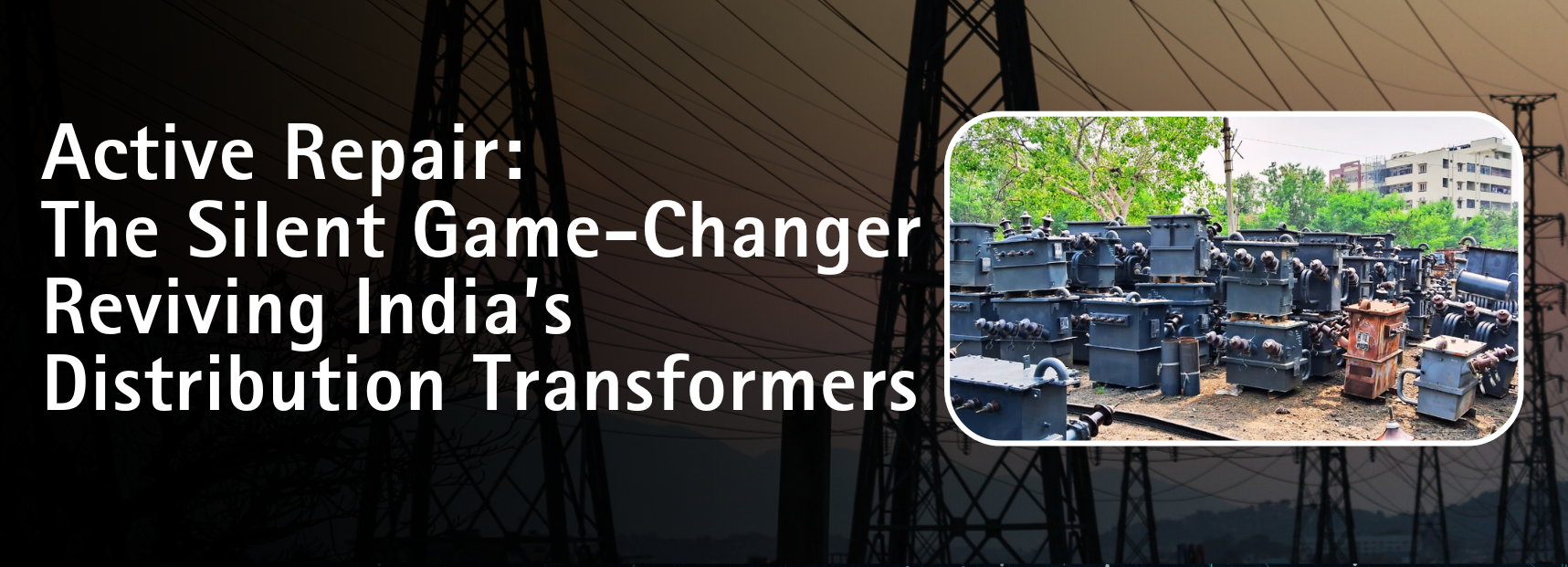
What if India didn’t need to replace millions of transformers every year; just repair them smarter?
Across India’s power distribution network, distribution transformers (DTs) quietly carry the weight of electrification, economic growth, and energy access. Yet, they remain one of the most failure-prone assets in the system. With over 1.5 million DT failures annually and refurbishment costs running into, utilities are trapped in a costly cycle of breakdown and replacement. A shift is underway and it is called active repair.
The Hidden Problem: Why Transformers Fail Early
Most legacy DTs fail long before their designed life due to a combination of electrical, thermal, and mechanical stresses. Field failure analysis shows a recurring weak point:
HT aluminium windings, particularly damaged from the inner side of the coil, leading to deformation, insulation breakdown, and eventual failure. It also leads to several more complications like:
- Overloading and voltage fluctuations
- Poor heat dissipation
- Oil degradation and moisture ingress
- Reactive, time-delayed repair practices
There snags result in rising technical losses, frequent outages, and escalating O&M costs for DISCOMs.
What Is Active Repair and Why It is Different
Active Repair goes beyond routine refurbishment. It is a data-driven, preventive, and performance-focused approach to transformer life extension.
Instead of waiting for failure, Active Repair:
- Diagnoses stress points early
- Targets vulnerable components
- Upgrades winding design and materials
- Restores efficiency close to original performance levels
This approach transforms DTs from liabilities into optimised assets.
Copper at the Core of Active Repair
One of the most impactful interventions in Active Repair is replacing or upgrading vulnerable aluminium windings with copper, especially in HT coils. Copper becomes the primary choice as it has –
- Higher electrical conductivity reduces I²R losses
- Superior thermal performance improves heat dissipation
- Better mechanical strength withstands short-circuit stresses
- Longer service life with lower failure probability
Field experience shared by utilities demonstrates that copper-intensive repair strategies significantly improve reliability while reducing lifecycle costs.
From Breakdown Repair to Performance Recovery
Traditional repair models focus on bringing transformers back online, but Active Repair focuses on bringing them back better. This not only reduces repeat failure rates, lowers technical and commercial losses, improves voltage stability at the consumer end and deferred capital expenditure on new DTs.
In a system where legacy transformers often hide 3%+ technical losses, even modest efficiency gains translate into massive system-level savings.
Supporting India’s Energy Transition
Reliable distribution infrastructure is foundational to renewable energy integration, EV charging expansion, rural electrification and digital and industrial growth.
Active Repair aligns directly with national priorities on efficiency, sustainability, and asset optimisation, while supporting India’s broader decarbonisation goals.
The Way Forward: Repair Smarter, Not Harder
As DISCOMs face mounting pressure to improve reliability and financial health, Active Repair offers a pragmatic, scalable solution; especially for the vast installed base of ageing transformers.
The question is no longer whether transformers should be repaired, but how intelligently they are repaired.
Because in India’s journey toward a resilient, electrified future, every transformer matters.